When a Person Dies, Do They Really Have 7 Minutes of Brain Activity? What Science Actually Shows
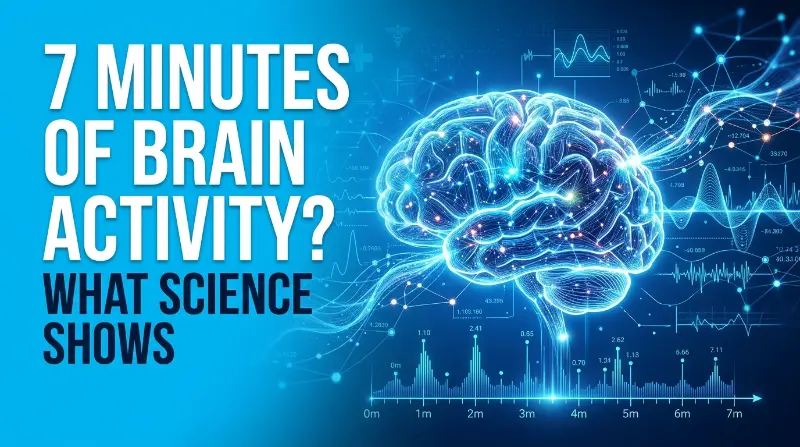
You have probably seen the post: when a person dies, their brain supposedly stays active for exactly 7 minutes, replaying every memory like a final dream. It is a haunting idea, and it spreads fast — but the specific “7 minutes” figure has no scientific basis. What science has actually recorded is much shorter, far stranger, and only partly understood. This explainer separates the documented research — including a 2013 University of Michigan rat study and a 2022 human EEG case — from the urban legend that grew up around it.
Where Did the “7 Minutes of Brain Activity” Claim Come From?
The claim circulates in slightly different forms, which is itself a red flag. Some versions say 7 minutes, others say 7–10 minutes, and a suspiciously precise variant claims “7 minutes and 10 seconds.” None of these numbers trace back to a single verifiable study.
The Viral Social Media Version?
The popular version states that after death the brain enters a 7-minute window in which it replays your memories “like a dream.” It reads like a documented fact but functions as an urban legend — a folk blend of two real threads: recorded electrical surges in dying brains and long-reported near-death “life review” accounts. The emotional appeal drives the sharing, not the evidence.
Why There’s No Single Study Behind the “7 Minutes”?
No peer-reviewed research has ever established a fixed 7-minute window of conscious memory replay. The measurable electrical events scientists have captured last on the order of about 30 seconds, not 7 minutes. The number appears to be a mashup of genuine EEG-surge findings and subjective near-death experience (NDE) reports, stitched together and rounded into a memorable figure.
Is the 7-Minute Claim True?
As stated, no. Documented dying-brain surges last roughly 30 seconds and come from one human case plus animal data; they cannot be confirmed as conscious memory replay, and the specific 7-minute duration has no support in the literature.
What the Number Gets Right — and Wrong?
What it gets right: the brain does not switch off the instant the heart stops, and there is real, organized electrical activity during dying. What it gets wrong: the duration (seconds, not minutes), the certainty (a single injured human brain is not proof), and the claim of a guaranteed conscious memory replay. Correlated brain waves are not the same as confirmed experience.
What Actually Happens to the Brain When You Die?
After the heart stops, blood flow ceases and the brain is starved of oxygen. EEG typically flatlines within about 2 to 20 seconds — yet transient surges of activity have been recorded right around that time, which is where the mystery begins.
Clinical Death, Brain Death, and Cellular Death Explained?
These terms are often confused. Clinical death means the heart and breathing have stopped and is potentially reversible with prompt CPR. Biological or cellular death begins roughly 4–6 minutes after clinical death as oxygen-starved cells start to die, and it is irreversible. Brain death is the irreversible loss of all brain function — and it can occur even while the heart still beats on life support.
| Death Type | Meaning |
|---|---|
| Clinical death | Heart stops |
| Brain death | Function lost |
| Cellular death | Cells die |
How Long Can Brain Cells Survive Without Oxygen?
Irreversible brain damage generally begins after about 3–6 minutes without oxygen. The most vulnerable neurons — those in the hippocampal CA1 region — can be fatally injured after roughly 10 minutes. Newer research complicates the tidy timeline: cells do not all die in one clean window, some die slowly over hours, and reperfusion (reintroducing oxygen) itself triggers rapid cell death. The key point is that there is no clean “7 minutes of consciousness” — detectable surges last about 30 seconds.
What Is the “Dying Brain Surge”?
The “dying brain surge” refers to a burst of organized, high-frequency electrical activity recorded around the moment blood flow to the brain stops. Two studies — one in rats, one in a single human — anchor the science.
The 2013 University of Michigan Rat Study?
In 2013, neuroscientist Jimo Borjigin and colleagues at the University of Michigan published findings in PNAS. In rats subjected to induced cardiac arrest, the brain produced a surge of high-frequency gamma oscillations within about 30 seconds — activity that was more synchronized than in normal waking. It was the first rigorous evidence that the dying brain generates an organized surge rather than simply going dark.
The 2022 Human EEG Case Study?
In 2022, Ajmal Zemmar and colleagues reported a striking human case in Frontiers in Aging Neuroscience. An 87-year-old man with epilepsy was on continuous EEG when he suffered a fatal cardiac arrest. In the roughly 30 seconds before and after blood flow stopped, recordings showed gamma oscillations — along with theta, alpha, beta, and delta rhythms — resembling patterns seen in dreaming, memory recall, and meditation. Activity was notable near the temporoparietal junction, a region tied to memory and out-of-body sensations. Zemmar suggested the brain “may be replaying a recall of life.”
Gamma Waves, Memory, and Dreaming?
Gamma oscillations are associated with high-level cognition, including memory and conscious perception. That association is why the 2013 and 2022 findings are so provocative. But association is not proof: gamma waves correlate with awareness without demonstrating it. Because patients die, their subjective experience cannot be confirmed, and skeptics offer alternatives such as REM sleep intrusion or generic aberrant activity in a failing brain.
Does Your Life Really Flash Before Your Eyes?
The “life flashing before your eyes” belief comes from near-death experience accounts, not from a proven replay mechanism — though recent brain data offer an intriguing, unproven candidate.
Near-Death Experiences and the “Life Review”?
The “life review” — a rapid cascade of autobiographical memories — is a commonly reported NDE feature, alongside tunnels, bright light, out-of-body sensations, and profound peace. The 2013 and 2022 gamma-surge data provide a plausible but unproven biological candidate for it. Separately, the AWARE research led by Sam Parnia at NYU Langone reports that some cardiac-arrest patients recall awareness and shows consciousness markers well into CPR — reinforcing that death is a process, not an instant.
Myth vs Reality: Debunking the “7-Minute Memory Replay”
The honest verdict: the exact 7-minute replay is unproven and, as stated, a myth. Real dying-brain surges last seconds, derive from one human case plus animal studies, and cannot be confirmed as conscious replay. The table below sorts the claims from what the data actually support.
| Claim | Reality |
|---|---|
| 7-minute replay | No basis |
| Brain surge | ~30 seconds |
| Life review | Reported, unproven |
What Do Scientists Still Not Know?
Major questions remain open. Scientists do not know whether the dying brain produces any actual subjective experience, or whether the 2022 single-case finding — recorded in an injured, seizure-affected, swollen brain — generalizes to healthy human deaths. The exact mechanism and duration of the surge are unclear, and it remains unresolved whether NDEs are neural artifacts or something else. That uncertainty is precisely why a confident “7 minutes” claim overstates the science.
Frequently Asked Questions
Is it true your brain stays active for 7 minutes after you die?
No. There is no scientific basis for a fixed 7-minute window. Recorded surges of organized brain activity last about 30 seconds, and EEG typically flatlines within roughly 2–20 seconds after blood flow stops.
Does your life really flash before your eyes?
A rapid “life review” is commonly reported in near-death experiences, and the 2013 and 2022 gamma-surge data offer a plausible biological candidate — but it remains unproven and cannot be confirmed as conscious experience.
What’s the difference between clinical and brain death?
Clinical death is when the heart and breathing stop; it can be reversible with prompt CPR. Brain death is the irreversible loss of all brain function and can occur even while the heart still beats on life support.
How long can the brain survive without oxygen?
Irreversible damage generally begins after about 3–6 minutes. Vulnerable hippocampal CA1 neurons can be fatally injured after roughly 10 minutes, though newer research shows cells die unevenly over time rather than in one clean window.
What did the 2022 dying-brain study find?
Zemmar and colleagues recorded EEG from an 87-year-old man during a fatal cardiac arrest. In the ~30 seconds around the loss of blood flow, they saw gamma and other rhythms resembling dreaming and memory recall — a single case, not proof of conscious replay.
Can a person hear or feel anything after they die?
Because the person dies, subjective experience cannot be confirmed. AWARE research suggests consciousness markers can persist into CPR, reinforcing that death is a process — but there is no verified evidence of awareness after biological death.
Where did the “7 minutes” myth come from?
It appears to be a folk blend of real dying-brain EEG-surge findings and near-death “life review” reports, rounded into a memorable number. Variants say 7, 7–10, or 7 minutes 10 seconds — none traceable to a single study.