How Do I Know If My Toe Is Broken or Just Bruised?
You stubbed your toe on a doorframe or dropped something heavy on your foot, and now it hurts, looks swollen, and is turning purple. The big question — is it broken, or just bruised? Both injuries share pain, swelling, and discoloration, so telling them apart at home can be tricky. This guide walks through the differences using guidance from Mayo Clinic, the NHS, Cleveland Clinic, Healthline, and OrthoInfo (AAOS), so you know what to check and when to get help.
This article is for general education only and is not medical advice. Only a doctor and an X-ray can confirm whether a toe is broken. See a healthcare provider if your pain persists or worsens, and go to the emergency room for red-flag symptoms such as a toe pointing the wrong way, an open wound with visible bone, numbness, or a toe that turns blue, pale, or cold.
Broken Toe vs Bruised Toe: What’s the Difference?
The core difference comes down to whether the bone itself is cracked. A bruise damages soft tissue and small blood vessels, while a break damages bone. Because a deep bone bruise can feel almost identical to a fracture, the NHS notes that without an X-ray the exact diagnosis stays uncertain. Still, the pattern and severity of your symptoms offer strong clues.
What a Bruised or Stubbed Toe Feels Like
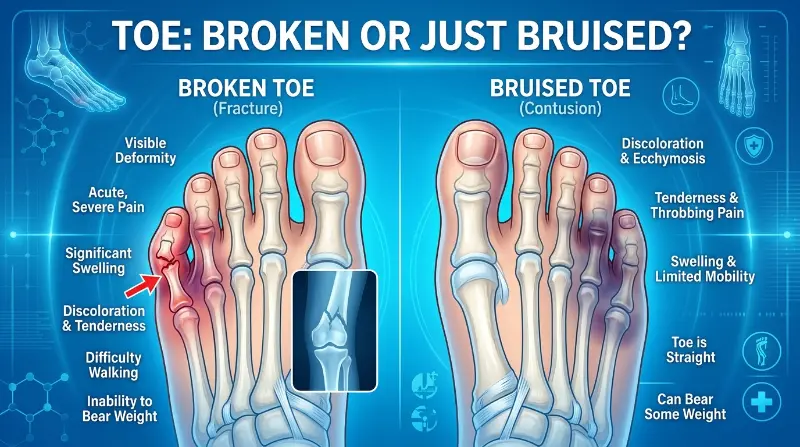
A bruised or stubbed toe usually brings mild to moderate pain that eases within a few hours to a couple of days. The swelling and discoloration tend to stay limited to one spot. The toe keeps its normal shape and alignment, you can still bend and move it, and you can usually still walk on it without too much trouble.
What a Broken Toe Feels Like
A broken toe tends to cause severe, sharp, or throbbing pain that stays or worsens rather than fading. Pain that has not eased after one to two days is a warning sign. You may see significant swelling and bruising spreading across the toe or into the foot, and the toe may look deformed, crooked, or point the wrong way. Bearing weight is often hard or impossible, movement is very limited, and some people hear a snap, pop, or crack at the moment of injury.
Signs That Overlap Both?
Both injuries cause pain, swelling, and bruising, which is exactly why they get confused. A bone bruise can mimic a fracture closely. Because of this overlap, the safest approach when symptoms are severe or not improving is to treat it seriously and get it checked rather than guessing.
How Can I Tell If My Toe Is Broken at Home?
You cannot confirm a fracture without imaging, but a few gentle self-checks can help you decide whether to wait or seek care. Do each one slowly and stop if pain spikes.
Compare It to Your Other Foot
Line up the injured toe next to the matching toe on your other foot. Look for obvious differences in angle, position, and swelling. A toe that sits crooked, rotated, or clearly out of line compared with its twin is a strong sign of a break and needs medical attention.
Find the Tender Spot
Gently press along the toe. Bruises tend to be sore over a general area of soft tissue, while a fracture often produces sharp, pinpoint tenderness directly over the bone. Severe pain concentrated at one bony point leans toward a break.
Test Gentle Movement and Weight-Bearing
Try to slowly bend and wiggle the toe. If you can move it fairly normally and put weight on the foot to walk, a bruise is more likely. If the toe is stiff, will barely move, or you simply cannot bear weight, that points toward a fracture.
Does Bruising Look Different on Darker Skin?
Bruising shows up as purple, blue, or black on lighter skin, but on darker skin tones it can be harder to see and may look like a darker patch than the surrounding area. If color is hard to judge, rely more on swelling, tenderness, shape, and your ability to move and walk on the toe.
Broken vs Bruised Toe: Symptom Comparison
The table below summarizes the everyday signs that most often separate a bruise from a break. No single row is proof on its own — look at the overall pattern.
| Sign | Likely Bruised | Likely Broken |
|---|---|---|
| Pain | Eases in hours | Severe, lingering |
| Shape | Looks normal | Crooked, deformed |
| Movement | Can move it | Stiff, can’t move |
| Weight | Can walk | Can’t bear weight |
When Should I See a Doctor or Go to the ER?
Some toe injuries can be watched at home, but others need prompt professional care. Knowing which is which protects the bone, the joint, and your long-term function.
Red Flags That Need Urgent Care
Seek emergency or urgent care right away if the toe sits at an odd angle or looks obviously deformed or dislocated, if there is an open wound or bone poking through the skin (an open fracture), or if you feel numbness, tingling, or loss of feeling. A toe that turns blue, pale, or cold signals a blood-flow problem. Also treat a suspected broken big toe, any injured toe in a child, and severe pain or heavy bleeding as reasons to be seen quickly.
When It’s Okay to Wait and Watch?
If the pain is mild to moderate, the toe keeps its normal shape, you can still move it, and you can walk, it is generally reasonable to try home care and watch for a day or two. If symptoms have not clearly improved after that window, or pain is getting worse, book a visit with your doctor.
How Do Doctors Diagnose a Broken Toe?
A clinician starts with a physical exam, checking the toe’s shape, tenderness, swelling, movement, and blood flow. To confirm a break, they order an X-ray, usually from multiple angles. The images reveal whether the bone is cracked, what type of fracture it is, and whether it is displaced — all of which guide the right treatment plan.
How Do You Treat a Broken or Bruised Toe at Home?
Many simple, non-displaced toe fractures and most bruises are managed with the same basic home measures. If a fracture is displaced or angled, a doctor may need to realign it (a reduction) first.
What Is the RICE Method?
RICE stands for Rest, Ice, Compression, and Elevation. Rest the foot and avoid the activity that caused the injury. Apply ice wrapped in a cloth for up to 20 minutes every few hours in the early days. Use gentle compression, and elevate the foot to reduce swelling. These steps ease pain and speed early recovery for both bruises and breaks.
Buddy Taping and a Stiff-Soled Shoe
Buddy taping means gently taping the injured toe to a healthy neighboring toe, with a small piece of gauze between them to prevent skin irritation. This is typically kept up for about two to three weeks to add support. Wearing wide, flat, stiff-soled shoes protects the toe and limits painful bending as it heals.
Pain Relief
Over-the-counter pain relievers such as acetaminophen or NSAIDs (like ibuprofen) can manage discomfort. Follow the label dosing, and check with a pharmacist or doctor if you have health conditions or take other medications that affect which option is safe for you.
How Long Does a Broken Toe Take to Heal?
A bruised or stubbed toe usually settles within a few days to about two weeks. A broken toe generally takes about four to six weeks to heal, with up to six to eight weeks for full recovery. Big-toe or more complicated fractures take longer, and mild aching can linger for months. Big-toe fractures may need a walking boot, cast, or rigid shoe for roughly two to three weeks, while open fractures, dislocations, or joint fractures sometimes require surgery. See a doctor if pain persists beyond about six weeks.
Frequently Asked Questions
Can a broken toe heal on its own?
Many simple, non-displaced toe fractures heal well with home care like RICE, buddy taping, and a stiff-soled shoe. However, displaced, big-toe, open, or joint fractures need professional treatment, so it is worth getting checked to confirm which type you have.
Can you still walk on a broken toe?
Sometimes yes, especially with a smaller toe, which is why walking is not proof the toe is fine. That said, difficulty or inability to bear weight leans strongly toward a break and is a reason to seek care.
How long does a broken toe take to heal?
Most broken toes heal in about four to six weeks, with up to six to eight weeks for full recovery. Big-toe and complicated fractures take longer, and mild aching can linger for months.
Do you need a cast for a broken toe?
Smaller-toe fractures are often treated with buddy taping and a stiff-soled shoe rather than a cast. Big-toe fractures may need a walking boot, cast, or rigid shoe for roughly two to three weeks.
Is a broken big toe treated differently?
Yes. The big toe carries more of your weight, so a suspected break should be checked promptly and may require a walking boot, cast, or rigid shoe, and occasionally surgery for severe fractures.
What’s the difference between a broken and a bruised toe?
A bruise damages soft tissue with pain that eases in hours to days, keeps the toe’s normal shape, and lets you move and walk. A break damages bone, causing severe lingering pain, possible deformity, and trouble moving or bearing weight.
When should I go to the ER?
Go to the ER for a toe at an odd angle or obvious deformity, an open wound or exposed bone, numbness or loss of feeling, a toe that turns blue, pale, or cold, a suspected broken big toe, a child’s injured toe, or severe pain and heavy bleeding.
The Bottom Line
A bruised toe usually eases within days, keeps its shape, and lets you move and walk, while a broken toe brings severe, lingering pain, possible deformity, and trouble bearing weight. When symptoms are mild and improving, careful home care with RICE, buddy taping, and a stiff-soled shoe is often enough. When they are severe, worsening, or include any red flag, get evaluated.
This article is for general education only and is not a substitute for professional medical advice. Because a bone bruise can mimic a fracture, only a doctor and an X-ray can confirm a broken toe. Please see a healthcare provider if you are unsure or your pain persists, and go to the emergency room right away for red-flag symptoms such as an obviously deformed toe, an open wound with visible bone, numbness, or a toe that turns blue, pale, or cold.