
How to Verify Peptide Lab Results: A Practical Checklist
|
Research-use note: This article explains how to assess analytical documentation. A certificate of analysis does not establish that an unapproved product is safe, sterile, effective, or suitable for human use. |
Quick Answer
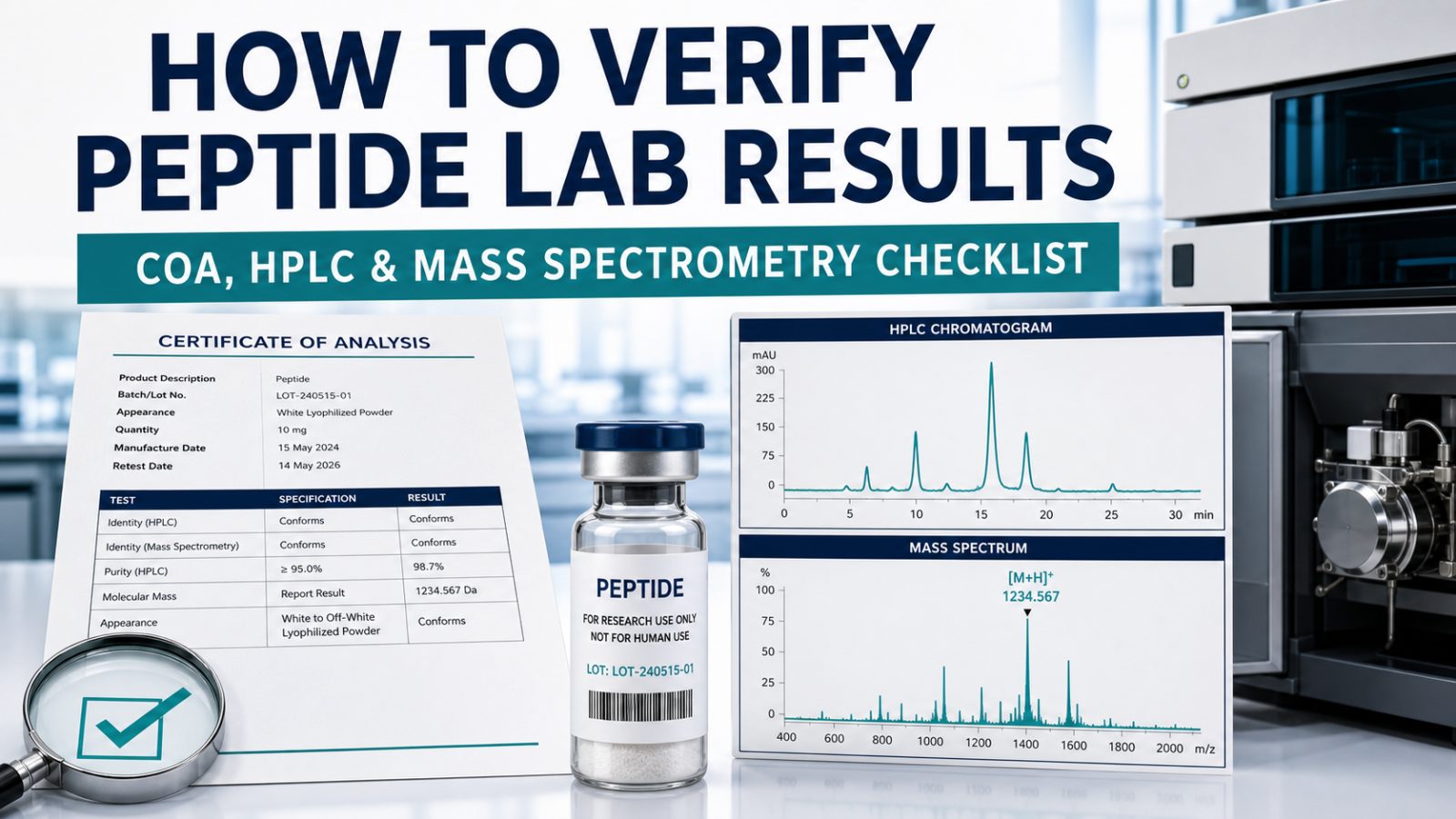
To verify peptide lab results, first confirm that the certificate of analysis is tied to the exact batch or lot in front of you. Then confirm the laboratory independently, review the actual HPLC chromatogram and mass-spectrometry output, and separate four different questions: identity, chromatographic purity, peptide content, and microbiological quality. A polished certificate that reports “99% purity” but omits a matching lot number, method details, raw plots, report date, and verifiable laboratory information is not strong evidence.
The strongest review uses multiple complementary tests. HPLC can show how much of the detected chromatographic area belongs to the main peak, while mass spectrometry can support molecular identity. Neither result, by itself, proves the amount of peptide in the vial, sterility, endotoxin status, clinical effectiveness, or suitability for use in people.
check independent peptide lab resources
What Each Lab Test Actually Tells You
|
Test or record |
What it can answer |
What it does not prove |
|
HPLC or UPLC |
Chromatographic purity and visible impurity peaks under the stated method |
Identity, vial content, sterility, endotoxin level, or safety |
|
Mass spectrometry |
Whether observed molecular mass is consistent with the intended peptide |
Absolute purity, exact vial quantity, sterility, or biological activity |
|
Assay or content test |
How much target material is present under a validated quantitative method |
Freedom from every impurity or microorganism |
|
Sterility test |
Whether viable contaminating microorganisms were detected under the method |
Endotoxin status, chemical identity, or potency |
|
Endotoxin test |
Whether bacterial endotoxin is below the stated limit |
Sterility, identity, or freedom from non-endotoxin contaminants |
|
COA and chain of custody |
Which sample and batch the reported data are said to represent |
That every vial or later batch is identical to the submitted sample |
How to Verify Peptide Lab Results Step by Step
- Match the report to the physical batch. Compare the peptide name, sequence or reference identifier when available, salt or counterion form, stated quantity, lot number, sample ID, manufacture date, and report date. The lot on the COA should match the lot printed on the vial or package. A generic report with no batch relationship cannot verify the material you received.
- Confirm the laboratory independently. Look up the lab through its own domain or an accreditation directory rather than relying only on a logo printed on the vendor’s PDF. Check its legal name, address, contact information, report-verification process, and the scope of any ISO/IEC 17025 accreditation. Accreditation is useful only when the relevant method falls within the lab’s scope.
- Verify the report identifier. A credible report normally includes an accession number, certificate number, sample ID, analyst or authorized-review field, and issue date. If there is a QR code, verify that it opens a lab-controlled report page rather than merely returning to the vendor’s product page. When doubt remains, contact the laboratory using contact details found independently and ask whether it issued that report.
- Inspect the methods and raw outputs. Do not stop at a summary table. Look for a complete chromatogram, integration table, instrument or method identifier, detector information, column and mobile-phase details where reported, run date, and a mass spectrum with observed ions. A screenshot cropped to a single peak or a certificate with only pass/fail wording is harder to audit.
- Compare the reported mass with the theoretical mass. Mass-spectrometry data may show several charge states rather than one obvious peak. The report should explain the ion assignment or provide a deconvoluted molecular mass. Compare the observed result with the theoretical value for the stated peptide form and allow only the method’s documented tolerance.
- Review the HPLC integration carefully. Confirm that the report shows the full run, the main peak, smaller impurity peaks, retention times, and integrated peak areas. Ask whether the reported percentage is area normalization, an assay against a reference standard, or another calculation. Those are not interchangeable.
- Check content separately from purity. A vial can show high chromatographic purity yet contain less target peptide than its label claims. Water, residual solvents, salts, counterions, and inactive material can affect net peptide content. Look for a specific quantitative content or assay result when the stated milligram quantity matters.
- Review microbiological claims only when they are tested. Sterility, endotoxin, and bioburden are separate measurements. A chemical purity result cannot establish any of them. The report should name the method, sample amount, acceptance criterion, result, and applicable units rather than using a vague “clean” or “lab tested” badge.
How to Read an HPLC Chromatogram
High-performance liquid chromatography separates components as they pass through a column. The detector records a signal over time, creating peaks at different retention times. The largest peak is often assigned to the target peptide, while smaller peaks may represent related substances, degradation products, synthesis by-products, or other detectable compounds.
A reported 99% HPLC purity often means that the main peak accounts for roughly 99% of the integrated detector response included in the calculation. It does not automatically mean that 99% of the powder’s mass is the intended peptide. Compounds that do not respond well at the selected wavelength, volatile material, water, counterions, or excluded peaks may not be represented in the same way.
- Check that the entire chromatogram is visible, including the baseline before and after the main peak.
- Look for an integration table listing every included peak and its retention time.
- Confirm that the total integrated area and reported purity are mathematically consistent.
- Watch for unexplained excluded peaks, a shortened run, overloaded peaks, or a distorted baseline.
- Treat retention time alone as weak identity evidence; a more specific identity test should support it.
How to Read Mass-Spectrometry Results
Mass spectrometry measures ions by their mass-to-charge ratio. For peptides, one molecule can carry multiple charges, so the raw spectrum may contain a family of peaks. Software can deconvolute those charge states into an estimated neutral molecular mass. A strong report shows the observed ions or deconvoluted mass and explains how they match the theoretical peptide.
A correct molecular mass is powerful identity evidence, but it is not a complete purity assessment. Different compounds can occasionally share a similar nominal mass, and closely related sequence variants may require high-resolution MS/MS, peptide mapping, or another orthogonal method. FDA quality guidance likewise treats a single chromatographic retention time as insufficiently specific and recognizes combinations such as HPLC with mass spectrometry as stronger identification approaches.
Purity, Identity, and Peptide Content Are Not the Same
This is the most common source of confusion. Identity asks whether the material is the intended peptide. Purity asks how much of the detected profile consists of the main component rather than related impurities. Content or assay asks how much target peptide is actually present. A careful COA reports these as separate measurements or clearly explains how one validated method supports more than one attribute.
For example, a lyophilized vial might produce a clean HPLC chromatogram and a matching mass spectrum while still containing a different net amount than the label states. The powder can include moisture, buffer components, counterions, or other non-peptide mass. That is why “10 mg vial” cannot be verified from HPLC area percentage alone.
Sterility and Endotoxin Require Separate Evidence
HPLC and mass spectrometry are chemical analyses. They do not establish that a sample is sterile. A sterility test evaluates whether viable microorganisms are detected under a defined method and observation period. Endotoxin testing addresses bacterial endotoxin, which can remain even when viable bacteria are absent. Bioburden testing answers another question by estimating microbial load before a sterilization step or at a specified stage.
If a seller claims sterility or a specific endotoxin limit, look for a separate report with the sample ID, method, acceptance criterion, result, units, and test date. Do not infer microbiological quality from a “99% purity” statement.
Common COA Red Flags
- The same certificate appears beside every batch, product size, or product page.
- The lot number on the report does not match the vial, or no lot number is shown.
- The report date predates the batch manufacture or sample-receipt date without explanation.
- The laboratory cannot be found independently, or the listed contact details belong to the vendor.
- A QR code opens a marketing page instead of a lab-controlled verification record.
- Only a purity percentage is shown; the chromatogram, integration table, and spectrum are missing.
- The report treats HPLC as proof of identity, content, sterility, endotoxin status, and safety.
- Units, specifications, acceptance criteria, method identifiers, or authorized approval are absent.
- Charts are cropped, low-resolution, edited, or inconsistent with the summary values.
- The seller will not provide a full report or permit confirmation with the testing laboratory.
Why Chain of Custody Still Matters
Even an authentic third-party report has a boundary: it describes the sample the laboratory received. If the vendor selected and submitted that sample, the result does not prove that every vial in the lot is identical, that later lots are equivalent, or that storage and shipping did not alter the material. Independent random sampling, documented chain of custody, sealed sample handling, and periodic retesting provide stronger evidence than a one-time vendor-selected submission.
Save the report with the lot information and record when the material was received. When a decision carries meaningful scientific, financial, or safety consequences, an independent laboratory should test a retained sample using methods appropriate to the question being asked.
Frequently Asked Questions
Is 99% HPLC purity enough?
No. It can be useful evidence of chromatographic purity under a stated method, but it does not independently verify identity, net peptide content, sterility, endotoxin level, or suitability for human use.
Does mass spectrometry prove the sequence?
A matching accurate molecular mass strongly supports identity, but sequence-level confirmation may require MS/MS fragmentation, peptide mapping, amino-acid analysis, or another orthogonal technique. The required evidence depends on the peptide and the risk of closely related impurities.
Can a COA be real but still misleading?
Yes. A genuine report can be presented beside the wrong batch, applied to later inventory, or described more broadly than the tests support. Verify the report, then evaluate whether the seller’s claim stays within the result’s actual scope.
What is the fastest verification check?
Match the lot number, confirm the report through the laboratory, and check whether both a full HPLC chromatogram and identity-supporting mass-spectrometry data are present. Those checks quickly expose many weak or generic certificates.
Final Takeaway
Verifying peptide lab results is not about finding one impressive percentage. It is about connecting the exact batch to an authentic report, understanding what each method can and cannot establish, and looking for complementary evidence. HPLC supports a purity assessment, mass spectrometry supports identity, quantitative assays address content, and microbiological tests address separate contamination risks.
A trustworthy review should survive independent confirmation. When the lot does not match, the lab cannot verify the report, raw data are missing, or a chemical test is used to imply sterility or safety, the correct conclusion is not “probably fine.” It is that the evidence is incomplete.
Selected Standards and Technical References
U.S. Food and Drug Administration, Q6A Specifications: Test Procedures and Acceptance Criteria for New Drug Substances and New Drug Products.
U.S. Food and Drug Administration, Biotechnology Inspection Guide; and Guidance for Industry: Synthetic Peptides.
International Council for Harmonisation, ICH Q2(R2), Validation of Analytical Procedures.
National Institute of Standards and Technology, Peptide Mass Spectral Libraries and peptide quantification-method research.